Long-Horizon Indoor Search
Within a relatively short path, the robot sweeps an unknown room almost in a full loop, achieving broad spatial coverage of the space before moving on.
CoRL 2026
1 Nanyang Technological University 2 Carnegie Mellon University
3 The Chinese University of Hong Kong 4 A*STAR Institute for Infocomm Research (I2R)
ObjectNav asks a robot to find an unseen target in an unknown home under partial observability. The core difficulty is deciding where to explore next over a long horizon — long before the target is ever observed.
First-person RGB policies keep appearance but discard spatial structure and act reactively over short horizons; text map summaries keep layout but flatten geometry and fine-grained visual cues. Both drift into repetitive search — turning in place, backtracking, and revisiting the same rooms.
Frontier-based Human-Intent Labeling looks ahead in low-level human trajectories and labels the frontier that best explains the demonstrator's future search direction — turning raw human actions into high-level BEV waypoint supervision, with no oracle shortest paths.
A VLM compares frontier and target candidates in one BEV decision space, each grounded by its egocentric visual memory and agent-centric geometry, then emits a reserved candidate-ID waypoint that transfers across embodiments.

We replay Habitat-Web human ObjectNav demonstrations and convert their low-level actions into candidate-level waypoint labels. When a target is verified we supervise it directly; otherwise we infer intent from how frontiers evolve, labeling the frontier the demonstrator actually committed to.
Exploration and target commitment are unified as selection over BEV candidates. Each candidate carries its first-observed egocentric visual memory and an agent-centric geometry feature, and an Intent-Aligned Objective smooths frontier choices by direction while keeping hard commitment to verified targets.
Trained only on MP3D demonstrations, IntentNav reaches the best SR and SPL among learning-based methods on MP3D, HM3D-v1, and HM3D-v2. The same checkpoint and candidate-level BEV interface transfer with no VLM fine-tuning across three physical robots.
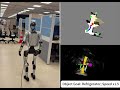
Executes IntentNav waypoint decisions through a mobile base controller.
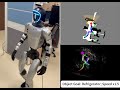
Uses the same high-level waypoint interface on a legged platform.
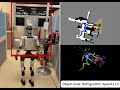
Uses the same high-level waypoint interface on a humanoid platform.
Within a relatively short path, the robot sweeps an unknown room almost in a full loop, achieving broad spatial coverage of the space before moving on.
At an informative viewpoint the robot scans in place, rotating to take in its surroundings and gather visual evidence before deciding where to search next.
A V-shaped peeking motion — walking into a region, finding nothing, and backing out — before semantic evidence of the target appears and the robot commits toward it.
The open space clearly holds no instance of the target, so the policy skips it and heads straight to another room where the object is semantically more likely to be found.
Frontier exploration and target commitment are unified in one BEV decision space, so the robot keeps searching and switches to decisive approach the moment the target is verified.
Carrying its BEV spatial memory across doorways, the robot searches room to room until the target appears.
The same MP3D-trained checkpoint drives the Go2 with no VLM fine-tuning — only the candidate-level BEV waypoint interface, while platform-specific local control handles legged locomotion.
IntentNav is a compact 2B VLM (InternVL3-2B) that runs on a single onboard laptop GPU at roughly 0.8 s per decision — light enough for real-time legged deployment.
A single extended episode: the quadruped explores a large space over a very long horizon, sustaining coherent directed search without collapsing into repetitive backtracking.
Decoupling high-level candidate selection from low-level control lets the identical waypoint policy run on legged hardware exactly as it does on wheels.
Each decision is a choice among frontier candidates on the boundary of explored and unknown space, plus target candidates from verified detections — all compared in one BEV space.
Instead of repeated VLM calls, the policy predicts a candidate-ID only as the robot nears its waypoint, so 2B inference overlaps with motion and never pauses the robot.
The hardest embodiment gap: the same MP3D-trained checkpoint drives a bipedal humanoid with no VLM fine-tuning, through the same candidate-level BEV waypoint interface.
Once the target is verified, the humanoid stops exploring and walks straight to the object — the high-level policy is unchanged while the body controller executes each waypoint.
Results are reported on MP3D-Val, HM3D (v0.1), and HM3D (v0.2) for fair comparison with prior work.
| Method | Training Regime | MP3D-Val | HM3D (v0.1) | HM3D (v0.2) | |||
|---|---|---|---|---|---|---|---|
| SR (%) ↑ | SPL (%) ↑ | SR (%) ↑ | SPL (%) ↑ | SR (%) ↑ | SPL (%) ↑ | ||
| Training-free methods | |||||||
| VLFM | Training-free | 36.4 | 17.5 | 52.5 | 30.4 | 63.5 | 32.5 |
| SG-Nav-GPT | Training-free | 40.2 | 16.0 | 54.0 | 24.9 | 49.6 | 25.5 |
| OpenFMNav | Training-free | 37.2 | 15.7 | 54.9 | 24.4 | - | - |
| TriHelper | Training-free | - | - | 56.5 | 25.3 | - | - |
| BeliefMapNav | Training-free | 37.3 | 17.6 | 61.4 | 30.4 | - | - |
| ApexNav | Training-free | 39.2 | 17.8 | 59.6 | 33.0 | 76.2 | 38.0 |
| WMNav | Training-free | 45.4 | 17.2 | 58.1 | 31.2 | 72.2 | 33.3 |
| PIGEON | Training-free | 41.6 | 14.4 | 57.9 | 32.3 | 79.2 | 36.8 |
| STRIVE | Training-free | 52.3 | 23.1 | 62.9 | 34.2 | 79.6 | 38.7 |
| SysNav | Training-free | 50.7 | 18.1 | 63.7 | 30.5 | 80.8 | 37.2 |
| Learning-based methods | |||||||
| DD-PPO | RL | 21.6 | 8.7 | - | - | 27.9 | 14.2 |
| Habitat-Web | Supervised | 14.6* | 4.94* | - | - | - | - |
| ZSON | Supervised | 15.3 | 4.8 | 25.5 | 12.6 | - | - |
| Navid | Supervised | - | - | 32.5 | 21.6 | - | - |
| PixNav | Supervised | - | - | 37.9 | 20.5 | - | - |
| ESC | Supervised | 28.7 | 14.2 | 39.2 | 22.3 | - | - |
| PONI | Supervised | 31.8 | 12.1 | - | - | - | - |
| SemExp | Supervised | 36.0 | 14.4 | - | - | - | - |
| CompassNav | Supervised | 42.0 | 17.5 | 56.6 | 27.6 | - | - |
| Generic policies | |||||||
| UniGoal | Generic | 41.0 | 16.4 | - | - | 54.5 | 25.1 |
| Uni-Navid | Generic | - | - | - | - | 73.7 | 37.1 |
| OmniNav | Generic | - | - | - | - | 56.1 | 30.0 |
| Ours | |||||||
| IntentNav (Ours) | Supervised | 53.8 | 23.1 | 70.5 | 34.6 | 82.2 | 38.5 |